

Zigzags, circles, colour and a field of ancient stone figures: the thinking behind Asel Yeszhanova’s plan for the Müsinder show in Almaty
GUEST POST: Asel Yeszhanova
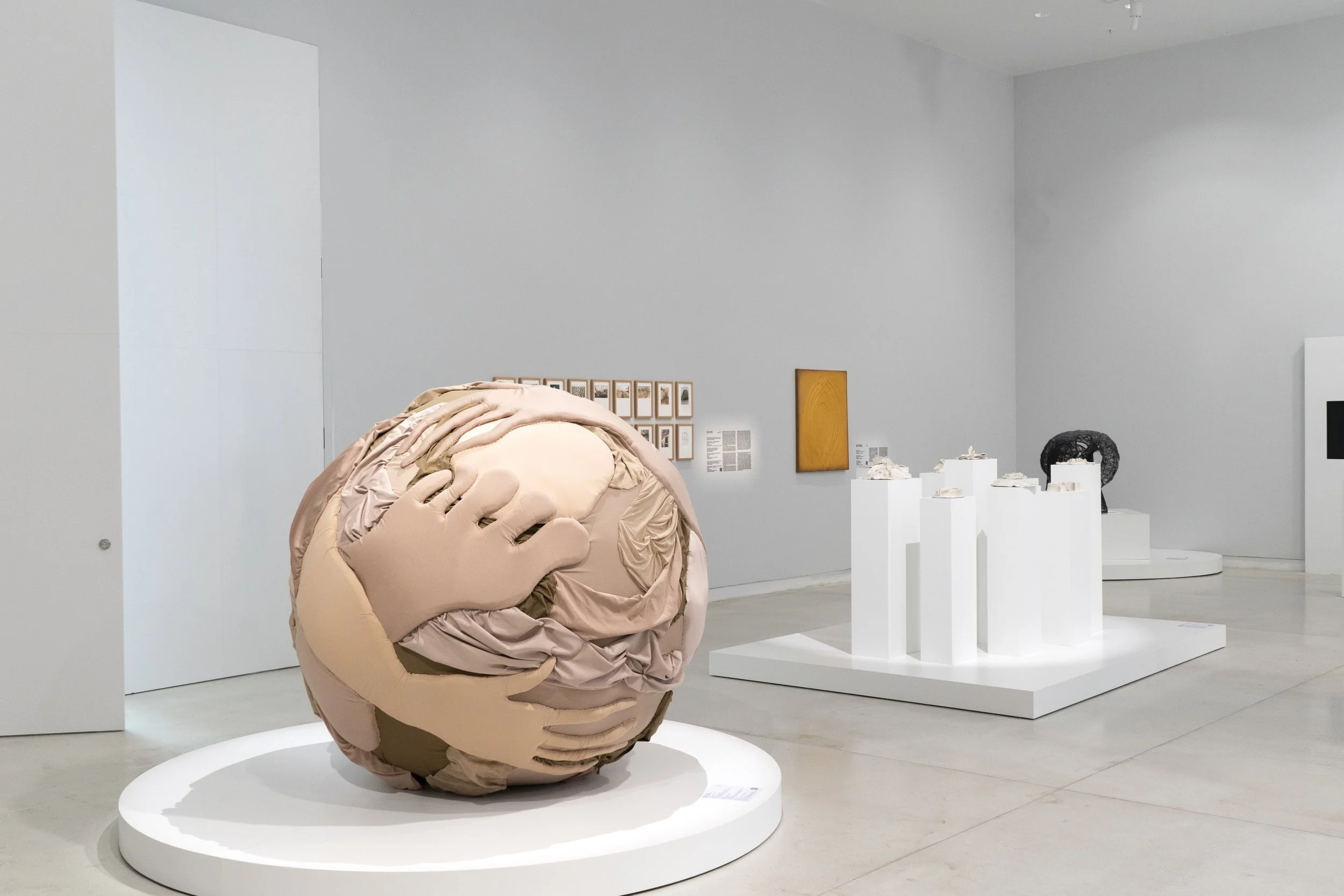
Müsinder at Almaty Museum of Arts. Photo by Roman Sazonov
EDITOR’S NOTE Recently I curated the Müsinder exhibition at the Almaty Museum of Arts in Kazakhstan. Dedicated to the last 70 years of sculpture in my home country, it takes visitors on an historical journey, encapsulated in works that range from a marble head to a textile ball. I thought you might be interested in a behind-the-scenes take on the show, and am delighted that artist, architect and urban activist Asel Yeszhanova, who was our head architect, has written a piece that takes us through her whole process. Aliya
I was invited to work on Müsinder as an architect, so this largely shaped my approach to the exhibition. Architecture, like sculpture, deals with three-dimensionality: volume and void, mass and weight, material, tectonics, and scale.
Neither architecture nor sculpture can be fully comprehended from a single viewpoint. We approach an object, move away from it, walk around it. First, we perceive its silhouette; then we begin to notice its material and details.
For an architect, however, another essential element comes into play alongside these complex relationships: the human body moving through space. Throughout the process of developing the exhibition, I was therefore less interested in exhibition design as a set of structures for displaying artworks than in the relationships between sculptures, the museum space, and the human body.
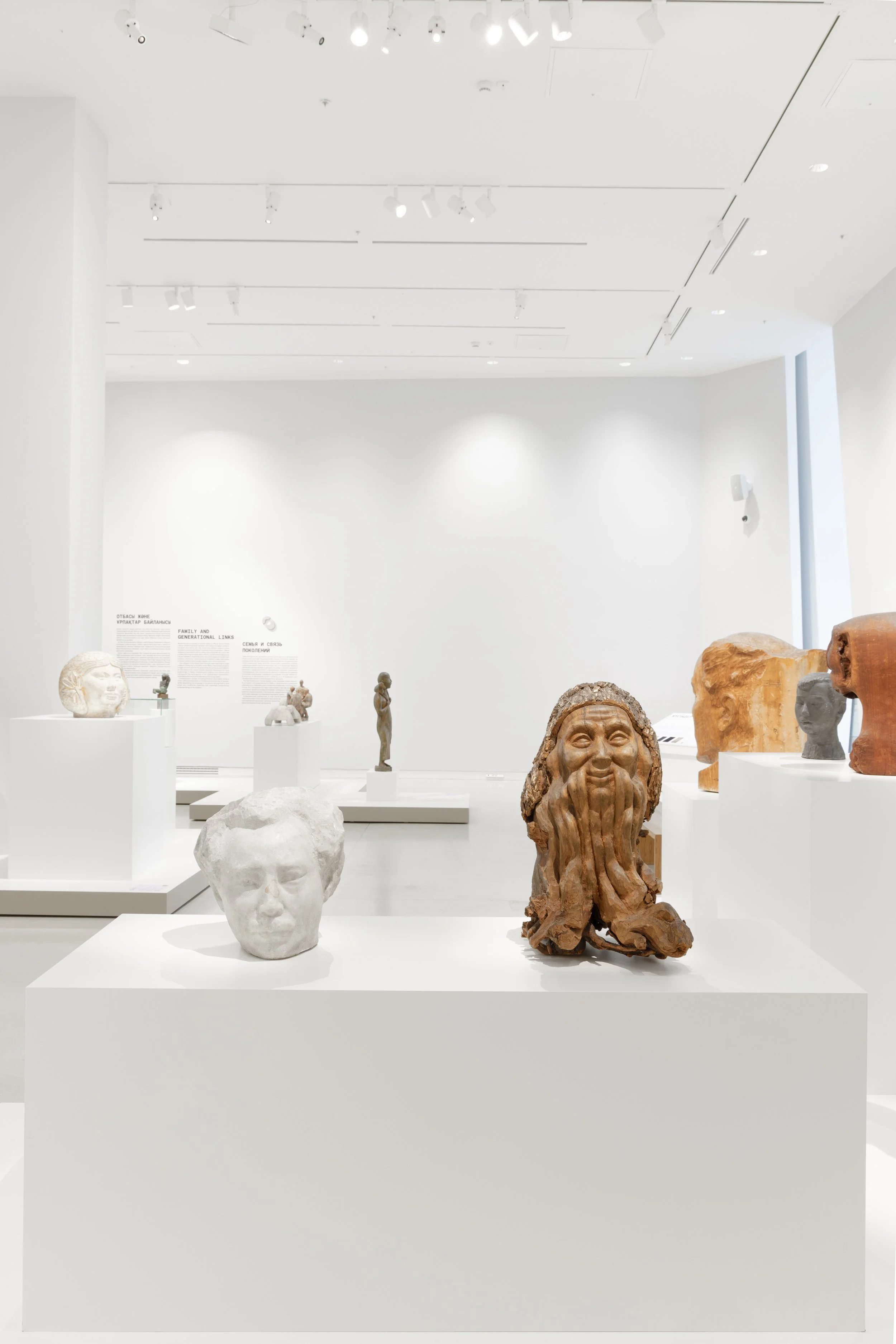
Müsinder at Almaty Museum of Arts. Photo by Roman Sazonov
Four themes, four shapes
When Aliya de Tiesenhausen and her fellow curator Inga Lāce first invited me to present my approach to the Müsinder exhibition, they asked me to propose possible scenographies for four already-defined thematic sections: the Soviet period; Motherhood and Family; Mythmaking and Independence; and Society and Body. I made an initial sketch by hand, trying to express the differences between these themes through the forms of the exhibition islands.
Now that the exhibition has been realised, I am almost surprised by how closely it follows that first drawing. Over several months of work, we refined the dimensions and positions of the elements, the sequence of the artworks, and the ways in which they would be displayed. New challenges emerged, but the underlying spatial logic of the four sections remained almost entirely intact.
For the section devoted to the Soviet period – now titled Game of Opposites? – we developed a relatively strict, rectilinear geometry: straight lines, sharp angles, and, in places, zigzags. I wanted the forms of the islands themselves to convey a sense of order, and the rigidity of the Soviet system.
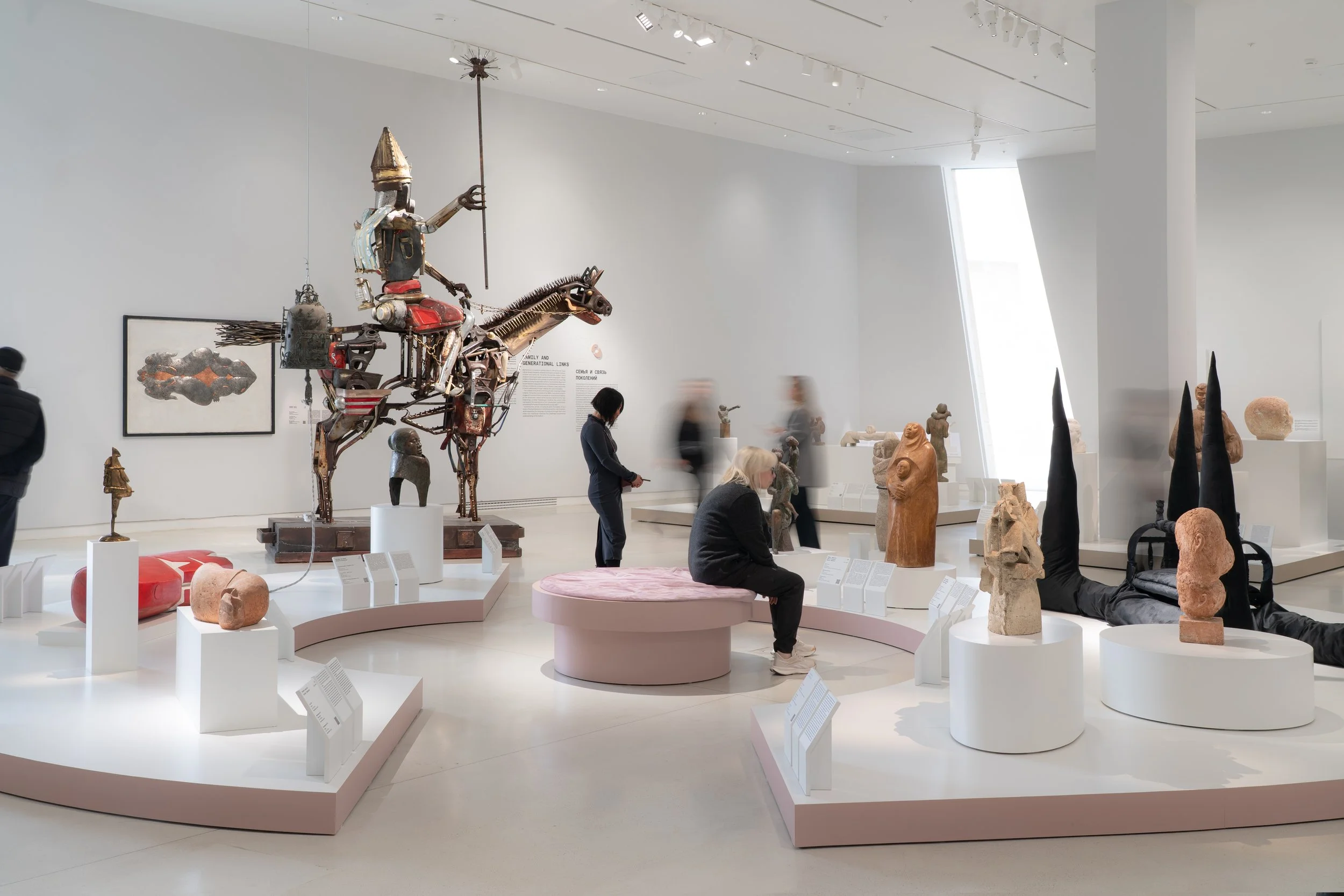
Müsinder at Almaty Museum of Arts. Photo by Zhanarbek Amankulov
The geometry of the Family and Generational Links section, by contrast, moves towards circles and a central point. For me, the image of a mother was associated with the centre of a family universe, around which multiple relationships take shape. The space therefore gathers around a shared centre, bringing different works together while allowing each to retain its own place.
In the History and Mythmaking section, which is dedicated to the years following Independence, the geometry seems to continue the lines established in the Soviet section, but becomes less definite. The lines break, loop, widen, and narrow; additional islands emerge, opening up several possible directions. For me, this reflects the early years of independent Kazakhstan: the previous trajectory remains visible, but new paths begin to open up for society as it searches for its own direction. One recurring motif in this section is the image of the rider and the horse. The spatial sequence culminates in a group of balbals – reminiscent of ancient stone sculptures.
For the final section, Body and Society: Acceptance and Confrontation, we deliberately abandoned the idea of a single unifying island. Here, different media and ways of occupying space come together: large-scale wall works, display cases, video, and freestanding objects. Bringing them all onto a single platform would have imposed a common composition on them and potentially deprived individual works of the autonomy they needed. It seemed important to preserve the sense of separate bodies and objects existing alongside one another within a shared space while retaining their own boundaries. This section also invited reflection on the extent to which we have become isolated as individuals.
At the same time, the geometry of the islands is most clearly legible on the floor plan, from a viewpoint that visitors will never actually occupy. People experience space at eye level, from within it. This presented us with another challenge: how could we help visitors sense the transitions between the four sections without turning the exhibition into a system of signposts?
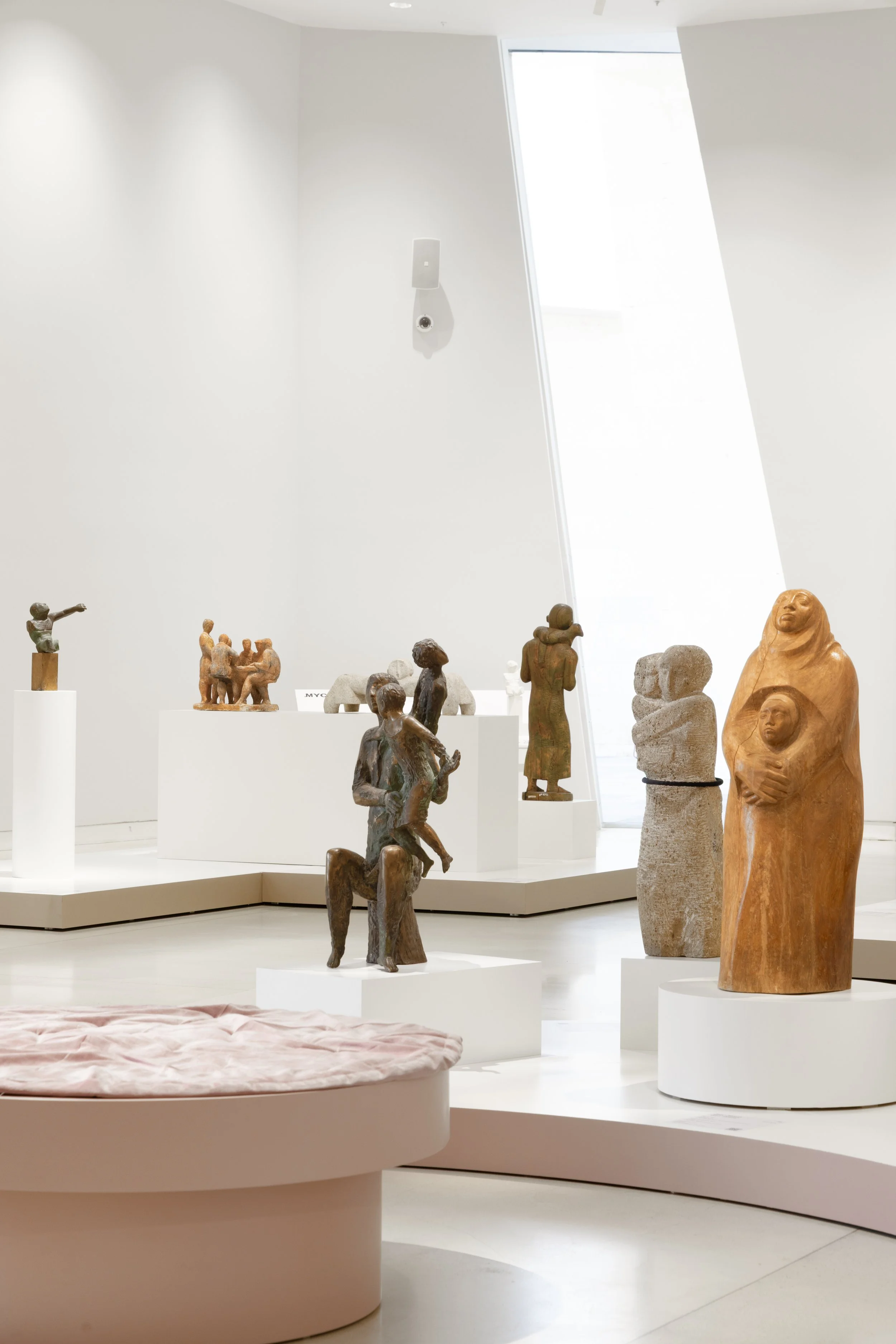
Müsinder at Almaty Museum of Arts. Photo by Roman Sazonov
Colour as a silent signpost
The answer emerged through colour, which we sought within the sculptures themselves, in the materials from which they are made: clay, bronze, wood, and white marble.
The Soviet period took on an earthy, clay-like hue. In the Family section, we began with red, which I associated with blood, birth, and the physical experience of motherhood. As we developed the palette, this evolved into a softer pink. Mythmaking acquired a bronze tone, while Body and Society was left white. Colour thus became an additional means of sensing the transition from one theme to another, even for visitors who would never perceive the overall geometry of the islands.
The islands also served a practical purpose. We wanted to preserve the immediacy of the encounter with sculpture and, wherever possible, avoid placing the works behind glass or other obvious physical barriers. We wanted visitors to be able to view a sculpture from different angles, approach it, and observe its surface and material. At the same time, many works are fragile. The low islands became a kind of soft boundary: they do not interrupt visual contact or explicitly prevent visitors from approaching, but they subtly suggest the distance that needs to be maintained.
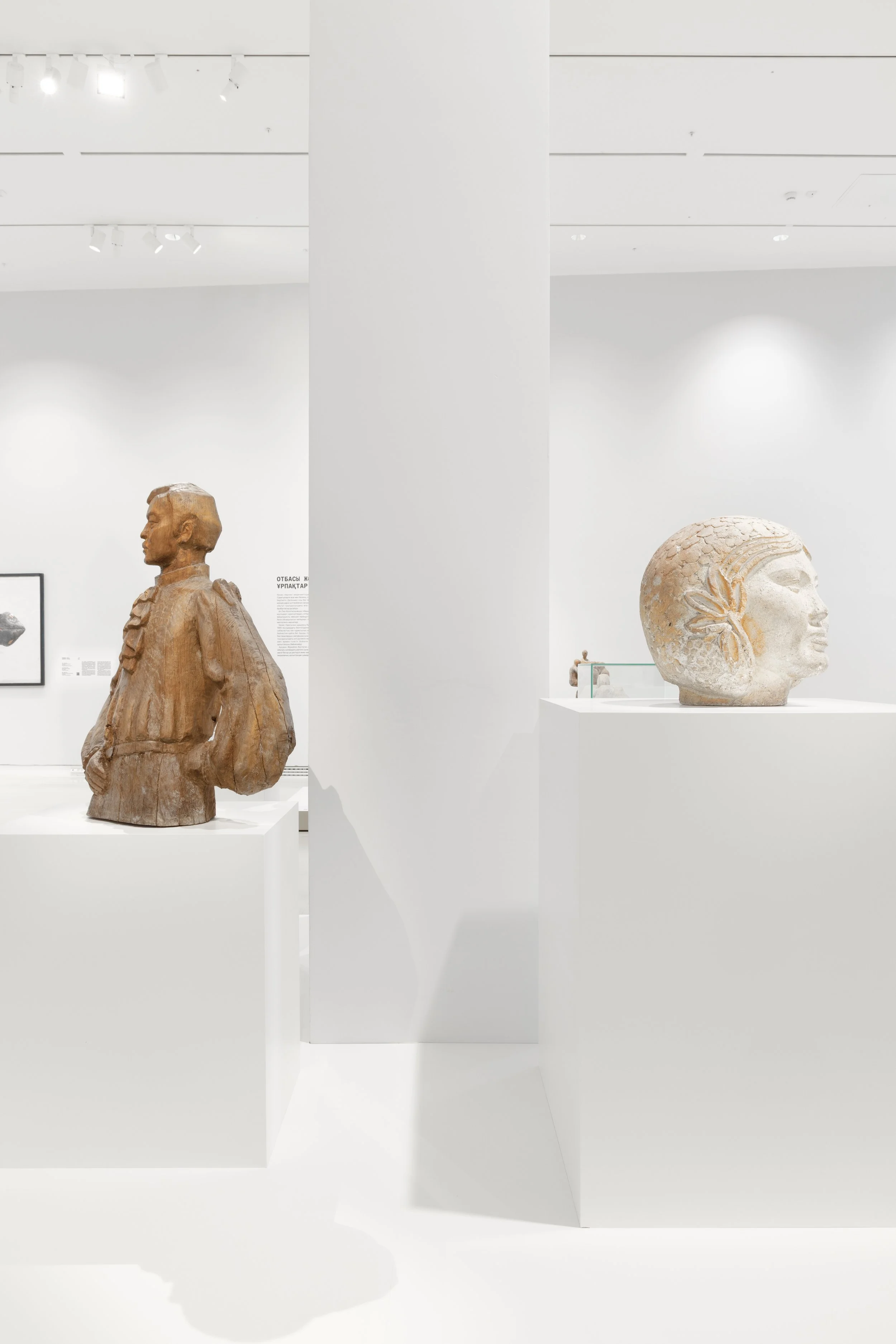
Müsinder at Almaty Museum of Arts. Photo by Roman Sazonov
The principle of contrast
Another important aspect of the work was the sequence of the artworks themselves. Together with the curators and my colleague Aniya Kudysheva, I spent a great deal of time thinking about which sculptures should be placed next to one another. Initially, we were guided largely by compositional considerations: which forms, sizes, and materials worked best together. Gradually, however, I came to appreciate the importance of the principle of contrast and contradiction that the curators had established.
This principle begins at the entrance, where two radically different works stand side by side: an almost archaic wooden head of an old man and a snow-white marble bust of Saken Seifullin – Soviet-era Kazakh writer and activist. Each work changes the way we perceive the other precisely because of the difference between them. The same principle recurs throughout the exhibition: something unexpected appears alongside something familiar; the works do not necessarily reinforce one another, but sometimes enter into tension.
In the Soviet section, for example, we brought together a group of works made by women or depicting women, including works by male artists. It was important to make this thread visible without turning it into a separate, formally defined section. We arranged these works on a shared island around an existing column. What might initially have seemed like an architectural obstacle proved useful: the column visually interrupts the group, preventing it from becoming too literal a closed circle.
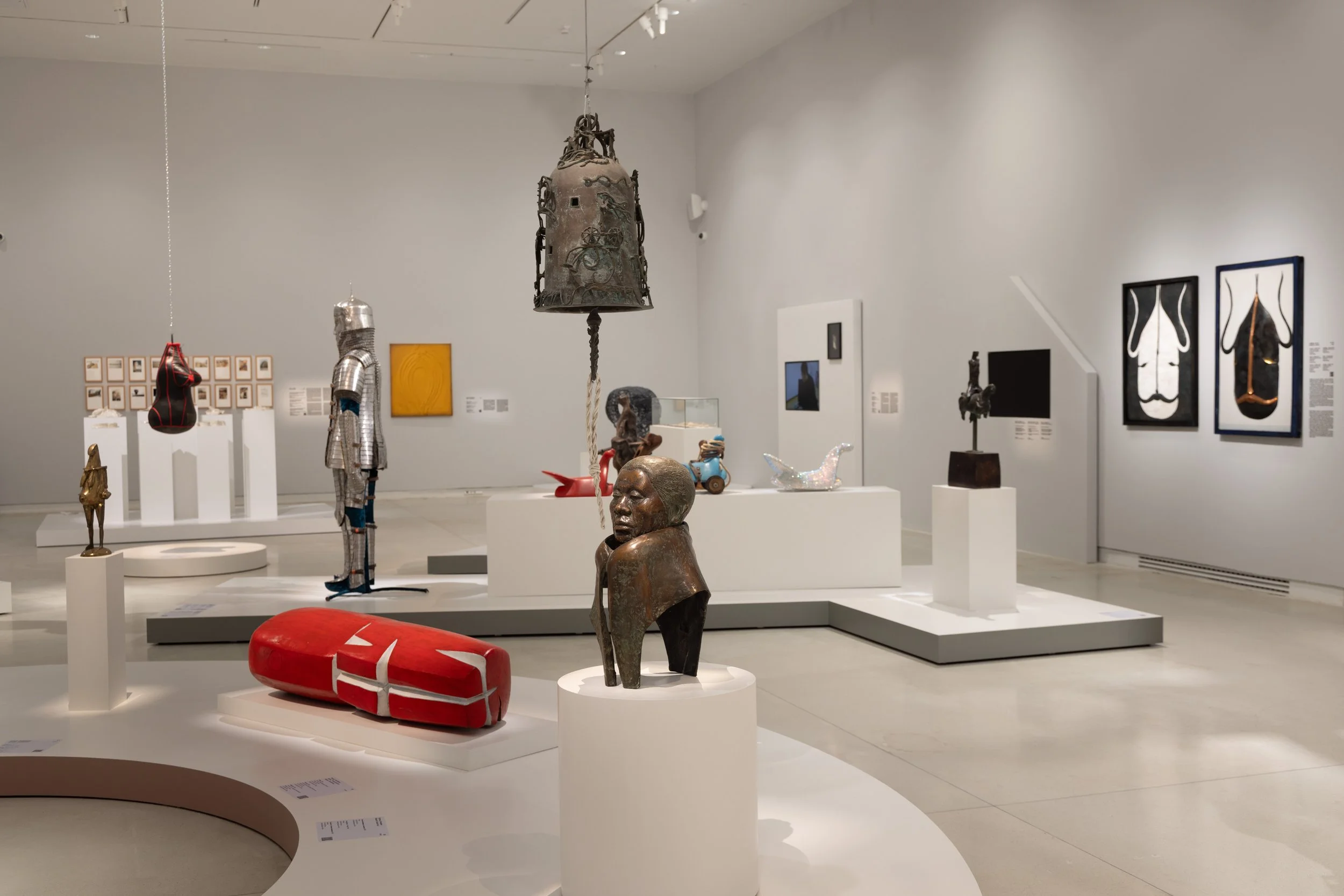
Müsinder at Almaty Museum of Arts. Photo by Roman Sazonov
Sightlines across the hall
Gradually, we began to think not only about the immediate relationships between two or more sculptures, but also about the composition of the entire hall. What happens as you move further into the space? Which volumes, materials, and colours enter into dialogue with one another across the room?
For example, Tamyr Besik, a large, dark work, occupies one of the main sightlines, set in contrast to the white Soviet busts. Elsewhere in the exhibition, one artist’s exploration of the shape of the balbal (an ancient, intricately-carved Turkic stone grave marker) enters into a spatial dialogue with another artist’s balbal. Relationships emerge not only between neighbouring works but also across the entire hall.
A special place in this arrangement is occupied by a group of fifteen balbals by Moldaqul Narymbetov, which we positioned on a specially-made island that resembles a field. For the curators, it was important to show that the history of sculpture on the territory of present-day Kazakhstan stretches far beyond the Soviet academic tradition, with balbals representing one of its manifestations. It is no coincidence that Narymbetov’s works are positioned at the exit, serving as the exhibition’s final chord.
One of the tasks set by the museum and the curators was to shape the visitor’s movement through the exhibition. Müsinder brings together almost seven decades of work by Kazakhstani artists in sculpture, and I wanted visitors to experience this history as a whole rather than simply select the most visible object from a distance, approach it, and leave the remaining works at the periphery of their experience.
At the same time, we did not want to prescribe a rigid route. We therefore worked carefully with the distances between islands, the passageways, the perspectives, and the sightlines. From different points in the hall, the next work needed to enter the visitor’s field of vision: visible enough to arouse curiosity and invite a closer look, but not so dominant that everything else faded into the background. Each view was intended to reveal another work or open up the next section.
The works needed to see one another across the space without bending towards or shouting over one another. Each sculpture needed room to breathe while remaining part of the overall composition. The distance between objects thus became as important a design material as the plinths, islands, and colours. The void between the works is not simply the space left over after everything has been arranged; it is an integral part of the scenography itself.
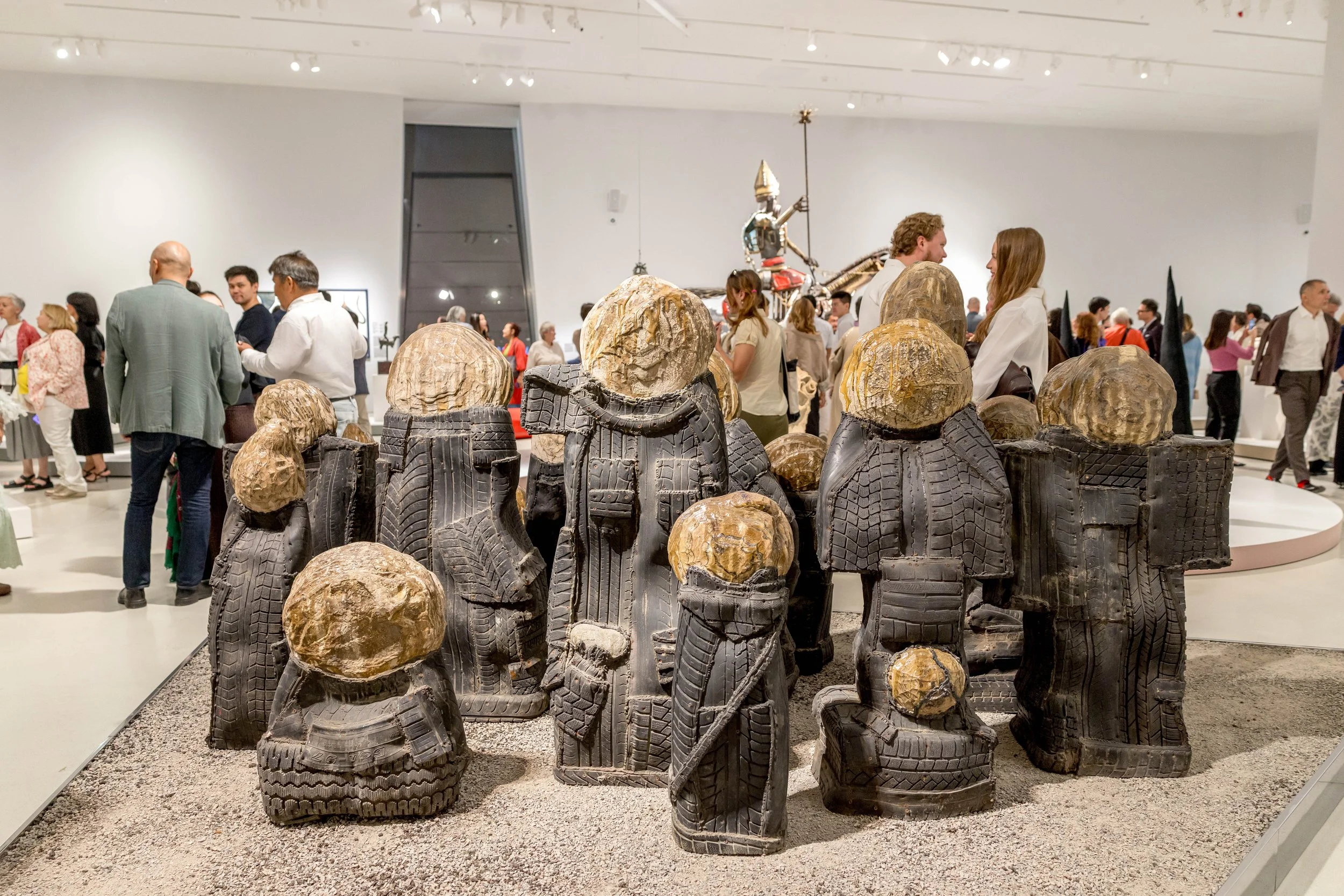
Müsinder at Almaty Museum of Arts. Photo by Evgeny Novikov
Please touch: the tactile table
A tactile table became another distinct element of the project. It is difficult to think about sculpture without thinking about touch. Materials possess qualities that vision can convey only partially: temperature, density, roughness or smoothness, and a sense of weight. Yet the museum environment inevitably limits our ability to touch most original works. We therefore introduced a table with samples of the principal materials used in sculpture, together with a replica of one of the sculptures that visitors could explore by touch.
Work on the exhibition began several months before installation and developed throughout that time through an ongoing dialogue. We regularly discussed solutions with the curators and the museum team, revisited the sequence of works, checked distances and sightlines, and refined dimensions and display methods. My colleague Aniya worked with me on developing the project. This extended collaboration allowed us to continually test the original concept and discover its finer nuances long before the works entered the exhibition hall.
Perhaps that is why I find it particularly interesting to return to the very first hand-drawn sketch. It was not a finished project; months of collaboration, discussion, and refinement still lay ahead. And yet the exhibition’s underlying spatial idea remained surprisingly close to that initial scheme.
Working on Müsinder allowed me to experience the kinship between architecture and sculpture with particular clarity. For me, the exhibition’s scenography became less about designing individual display structures and more about working with volume and void, mass and material, distance and colour, perspective and movement.
Ultimately, it was about carefully calibrating relationships: between one sculpture and another, between the artwork and the museum’s architecture, and between the sculpture and the human body.
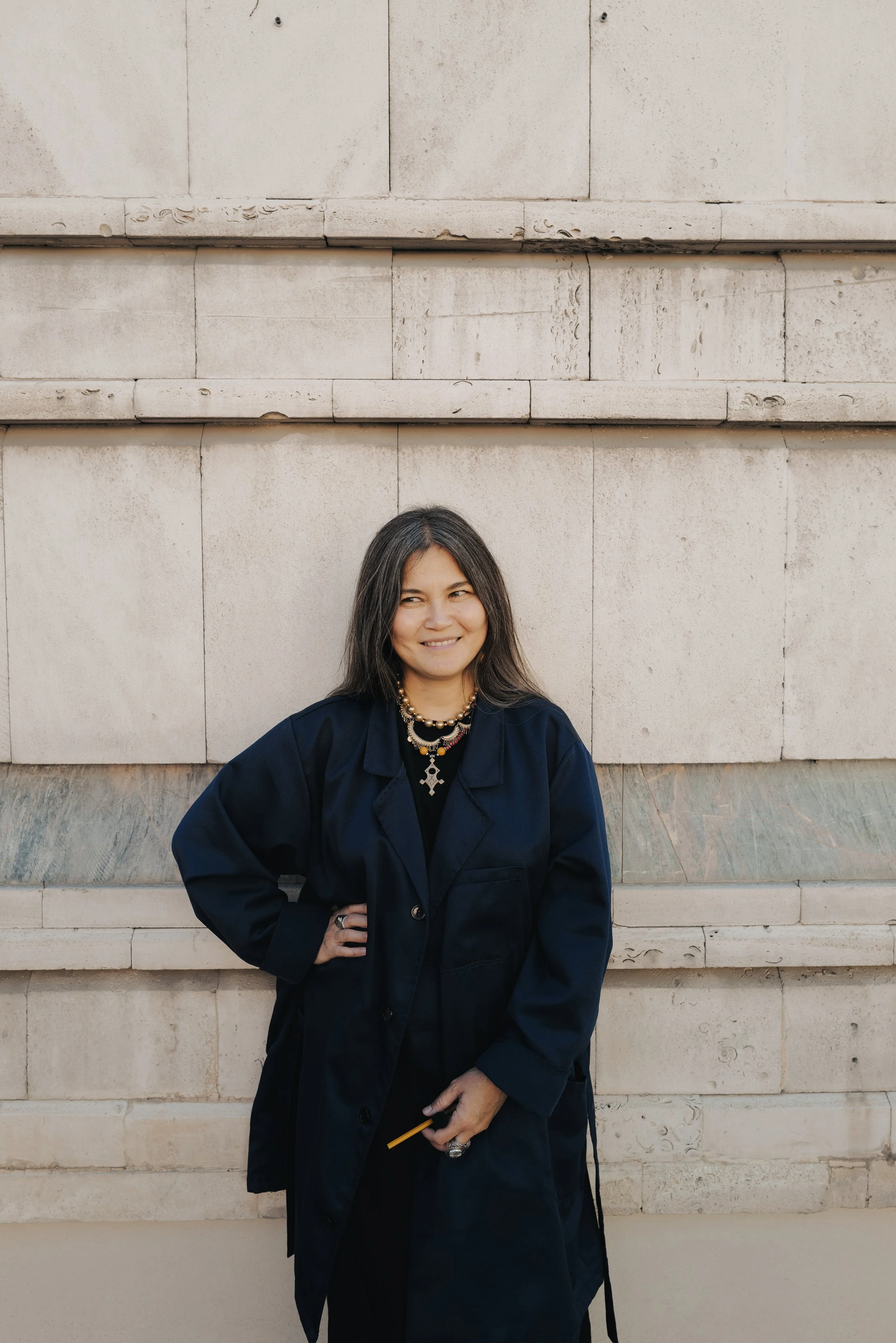
Asel Yeszhanova is an architect and artist based in Kazakhstan, working across architecture, urbanism, art and education. Much of her work grows from an interest in the relationships between people, place and landscape, with a particular interest in social and environmental questions. She is a co-founder of Urban Forum Kazakhstan and was included in RIBA’s 100 Women: Architects in Practice.
More about Asel’s work: Urban Forum Kazakhstan · Maktab/Mektep · Make Mektep · Instagram