

Christmas Special: The Sacred, The Scientific, and the Space Between
A journey through three National Gallery rooms that expose the surprisingly tender marriage of religion and science.
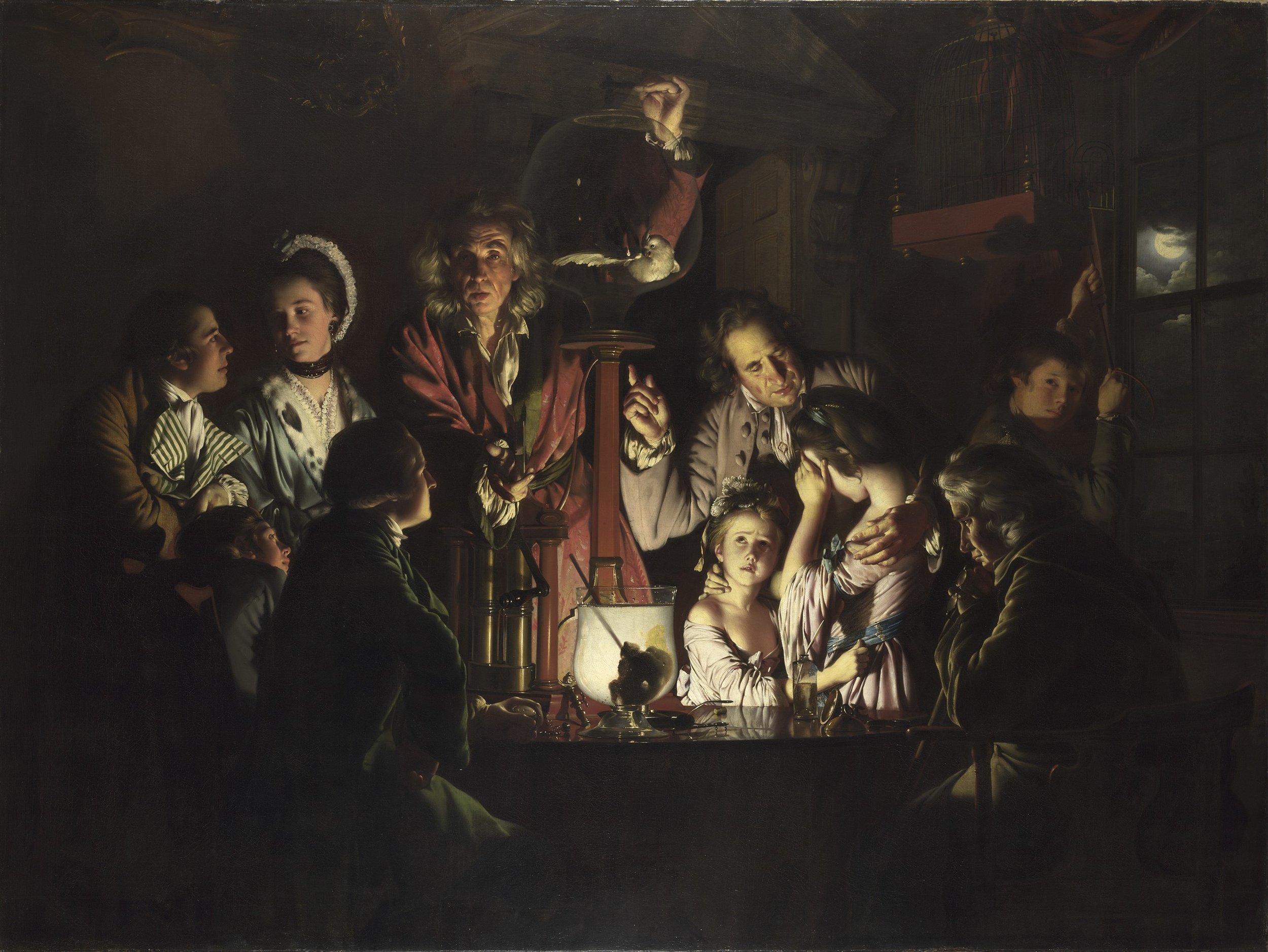
Joseph Wright 'of Derby', An Experiment on a Bird in the Air Pump, 1768, Oil on canvas, 183 x 244 cm, © The National Gallery, London
Will the bird live or die? A dramatically lit scene in Joseph Wright of Derby’s painting An Experiment on a Bird in the Air Pump has suggestions as to the bird’s fate, but no definite answers.
Encased in the glass bowl of the air pump, the white bird is already limp. A human skull floats gruesomely in the water jar below. But who will make the decision? A god-like scientist conducting this unsettling experiment is looking out of the painting and directly at us – the viewers. He will decide.
The National Gallery is using this painting, which it owns, as a central work in their current exhibition Wright of Derby: from the Shadows. The show is not very big – just one room in the centre of the gallery – but every painting in it makes you feel you’ve been privy to an exceptional event. The settings are sometimes banal (a girl’s desk, a blacksmith’s shop); it is the lighting that makes them seem otherworldly.
In the late 1700s, the fashionable word was ‘sublime’ – meaning something terrible, yet also delightful and reflective. And these works express it very well. In the painting of the bird experiment, we are possibly witnessing death, yet it also conveys the importance of life and the grandeur of science.
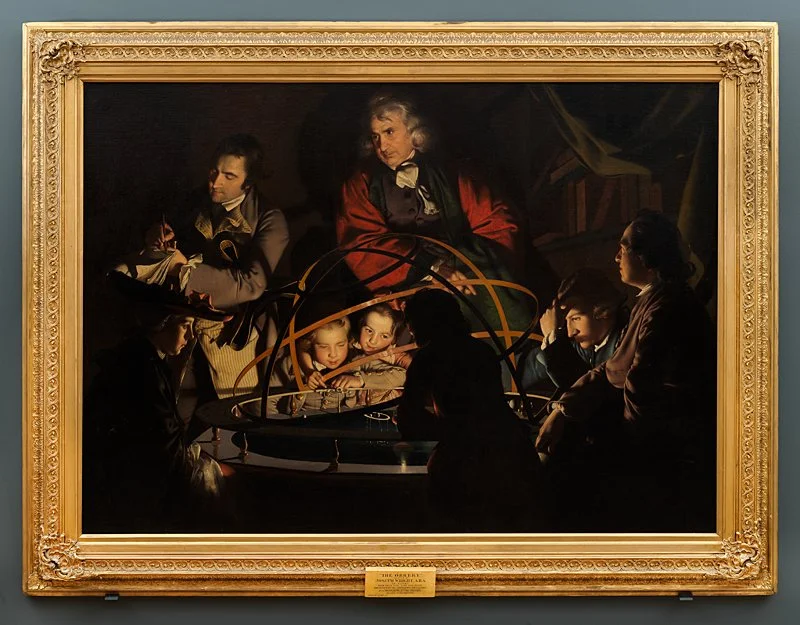
Joseph Wright of Derby, A Philosopher Giving That Lecture on the Orrery in Which a Lamp Is Put in Place, 1764-1766, Oil on canvas, 147.3 x 203.2 cm, Derby Museum and Art Gallery (1884-168), © Derby Museums
All human life is portrayed by the characters around the table where the experiment is taking place. The couple of lovers on the left aren’t even paying attention to the scientist’s tricks. There are young children, and men of various ages in different states of distress, excitement and contemplation. There are the skull and the almost-dead bird in the centre.
What’s most dramatic, however, is the light that comes from the suggested candle, which we don’t see. What we do see is the illuminated water jar – yes, the one containing the skull. The rest of the room is cloaked in darkness, creating a feeling of spookiness and of exclusivity – we are now part of this show-cum-experiment.
In another painting depicting the demonstration of an orrery (a mechanical model of the solar system), the characters are less distressed, but no less fascinated.
Joseph Wright fused distinct contemporary fashions in his paintings. First, the effect of the sublime, achieved by dramatic lighting, second the interest in science. He presented the scientist (or philosopher as Wright called them) as a god-like figure. In the late 18th century, science and religion were not necessarily seen as opposing fields as they are today. The laws of science were thought to be governed by the Deity.
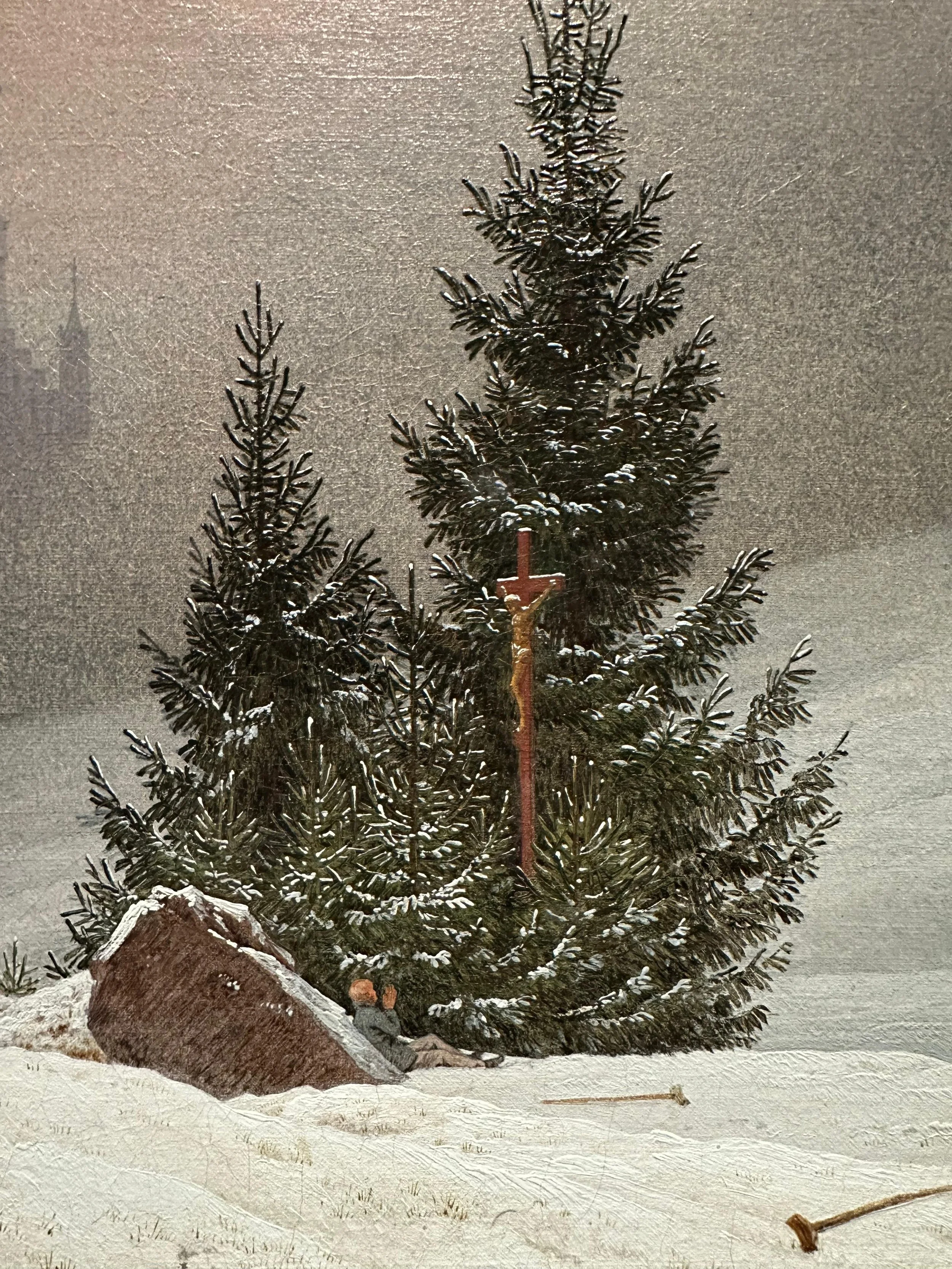
Detail of Caspar David Friedrich, Winter Landscape, probably 1811, Oil on canvas, The National Gallery, London, photo by the author
Around 1811, in Germany, Caspar David Friedrich addressed the sublime in his own way. Winter Landscape is a quiet exploration of belief that gives me a combination of chills and calmness every time I see it.
Currently on display in room 39 of The National Gallery, it portrays a snowy landscape with three fir trees at the centre. A small human figure sits next to the trees, praying to the cross, having abandoned their crutches. In the distance we see a gothic cathedral in the mist, and the gate leading to it.
To paint this work the artist used several highly scientific methods for the day: the concept of perspective, the understanding of natural phenomena, and complicated paint mixes. We can see tiny shoots of grass peeking through the snow all around the foreground, suggesting spring and therefore rebirth.
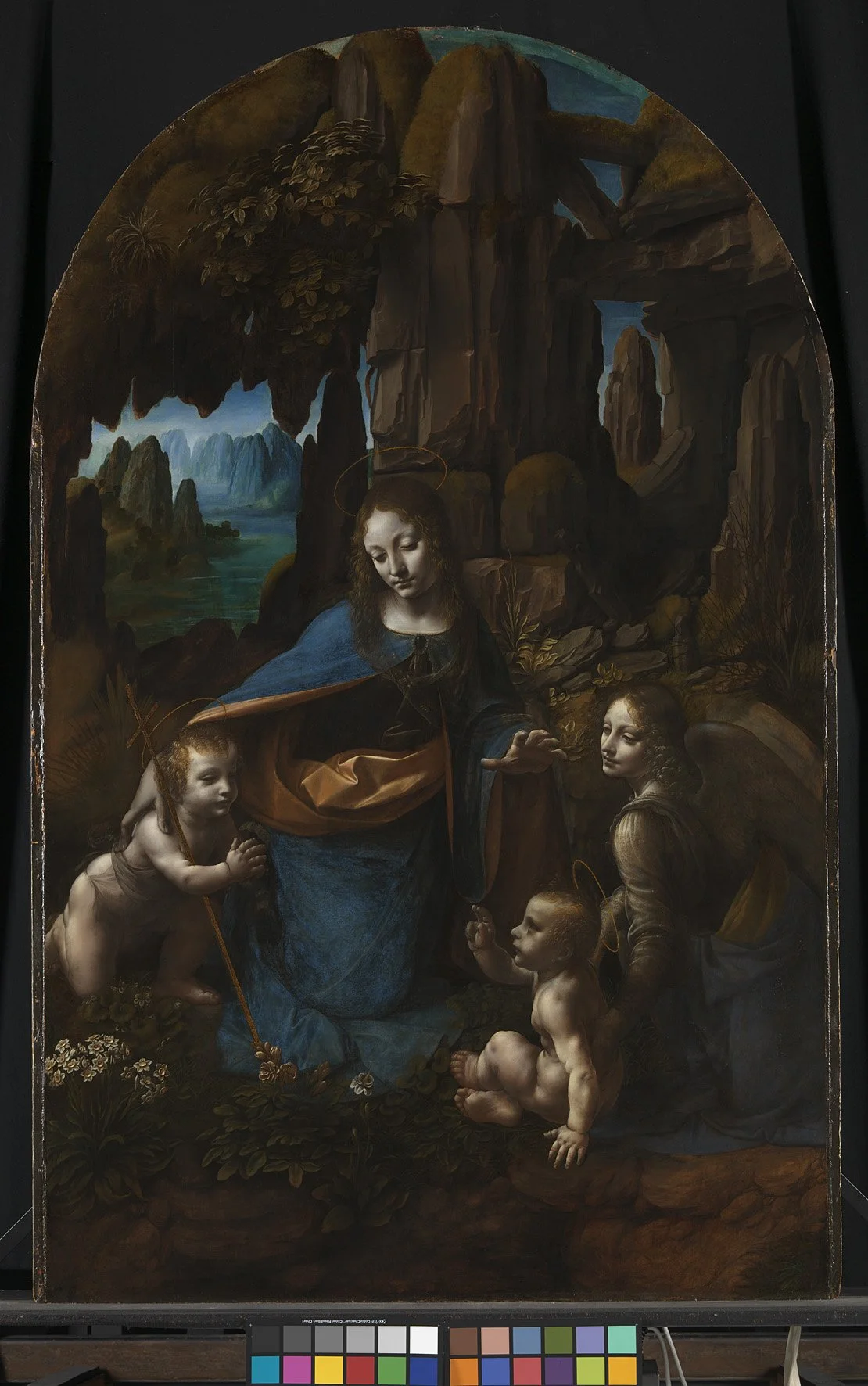
Leonardo da Vinci , The Virgin of the Rocks (The Virgin with the Infant Saint John adoring the Infant Christ accompanied by an Angel), about 1491 - 1508 , (c) National Gallery, London
To observe the link between science and religion in even starker contrast, head to room 51, the first in the newly refurbished and rehung Sainsbury wing, which houses the gallery’s oldest works. This offers a journey from the 14th to the 15th century and in several depictions of Virgin and Child we can trace the evolution of painting in Europe.
There’s the ethereal but stiff Mary of the Wilton Diptych, holding her infant’s toe between her fingertips. Leonardo’s playful, chubby babies. Michelangelo’s strict Madonna pulling a book away from the child, while her breast is on display. What is going on here? A lot, most of which has very little to do with religion, even though that was a crucial starting point.
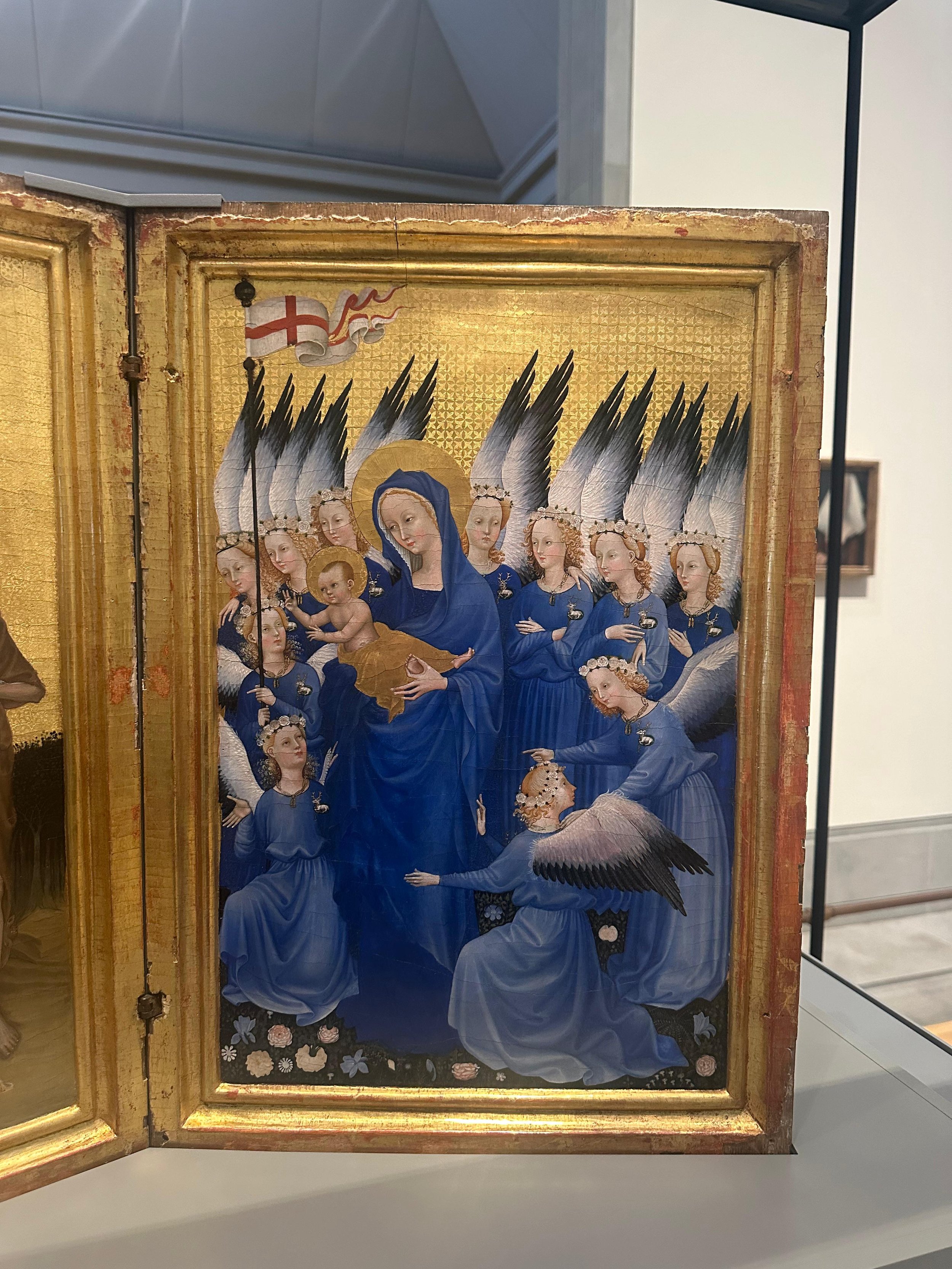
Detail of the English or French (?), The Wilton Diptych, about 1395-9, Egg tempera on wood, The National Gallery, London, photo by the author
This room demonstrates how the techniques of painting changed, from using egg tempera (paint made by mixing pigment and egg) on wood, to using oil on canvas. The first required fast application with little room for changes, the second was much more fluid and forgiving, allowing more complex shading.
It seems the artists of the time used religious symbolism like we use Christmas today – as an excuse for what we really want to do. For us, it is gifts and some mulled wine, for them it was a little bit perspective here, a little bit of shading there, just to see what happens. Mary was still dressed in blue, but she was now a flesh and blood woman that needed help to look after her kid, sometimes from a grandma, or maybe from some not-otherwise-occupied angels.
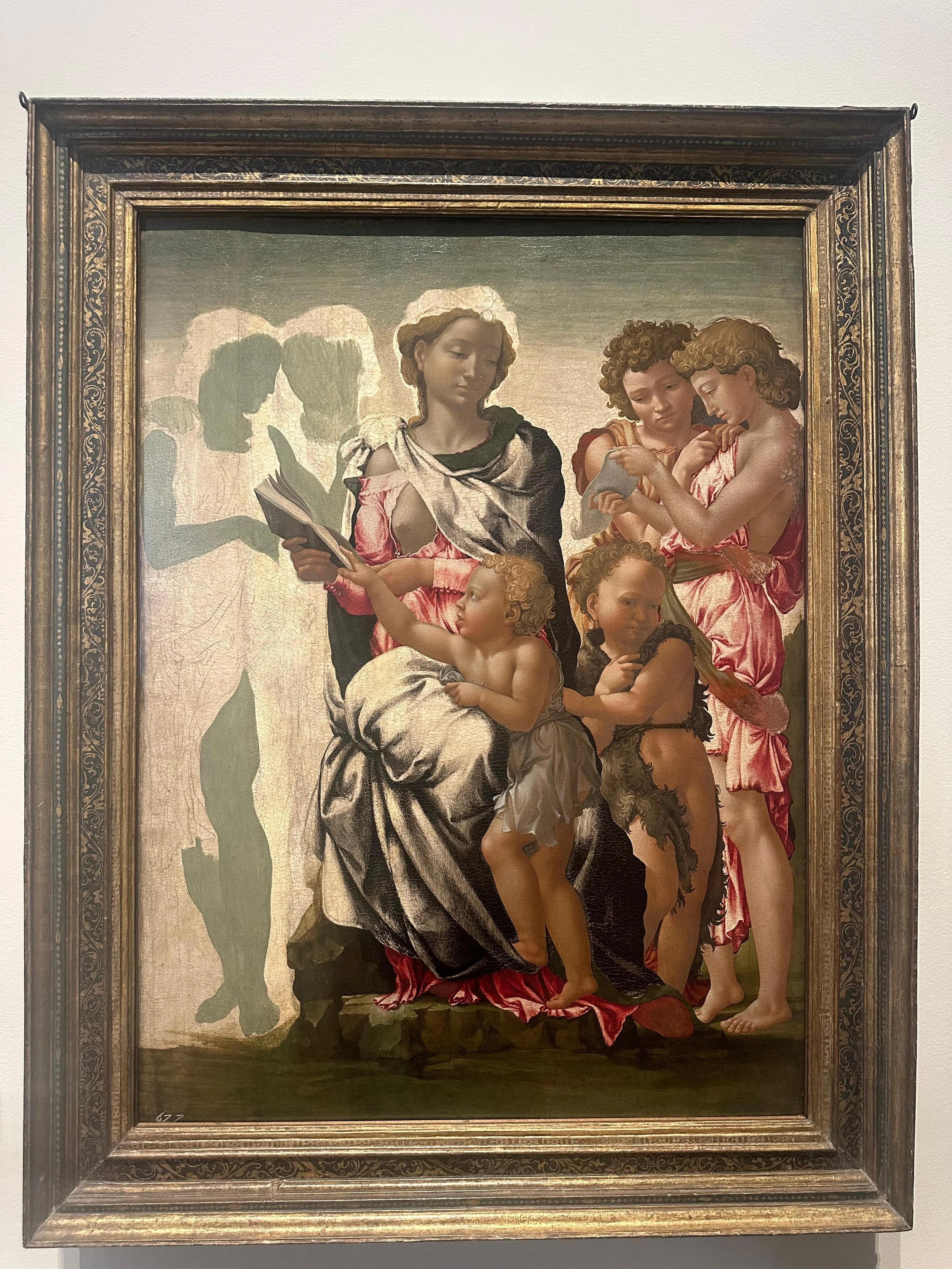
Michelangelo, The Manchester Madonna, about 1494, Egg tempera on wood, The National Gallery, London, photo by the author
Museums nowadays are not only places where you can see art, but institutions researching and sustaining their collections. Often this involves complex scientific methods for storage and conservation of art works. So that we can visit and enjoy the paintings, some over 500 years old, in all their glory.
Made originally to celebrate God and Christian belief, they are now a reminder of the generations of inventors, scientists and artists whose work was needed to create and make them so compelling – or, may I say it, sublime.